
 INSIGHTS
 In recent years, cross-border patent disputes have intensified, drawing an increasing number of Chinese companies into major global litigation. Among the available remedies, injunctions often exert the most immediate and disruptive commercial impact. This series explores injunction practices in leading IP jurisdictions, analyzing their structural features and providing practical strategies to help Chinese companies manage legal risks when expanding overseas.
On 15 December 2023 the Rio de Janeiro State Court issued a first-instance judgment in DivX v. Netflix, granting Brazil’s first permanent injunction in the information and communications technology (ICT) sector. Netflix was also ordered to pay USD 4 million in penalties and other legal costs for failing to comply with an earlier preliminary injunction. The decision underscores the Rio de Janeiro court’s pro-patentee stance and highlights Brazil’s growing significance as a jurisdiction where injunctions can serve as powerful leverage in patent disputes. For Chinese companies, understanding Brazil’s injunction framework is now critical for effective risk management in overseas markets.
1. Contents of Injunctions in Brazil
1). Types of injunctions
Brazilian courts issue two primary forms of injunctions: preliminary injunctions and permanent injunctions.
A preliminary injunction is a provisional measure granted at the outset of litigation to prevent alleged infringement that could cause irreparable harm before the merits are adjudicated. A permanent injunction, by contrast, is granted after a full examination of the case and a judicial finding of infringement.
Notably, Brazil’s Industrial Property Law draws no distinction between Standard-Essential Patents (SEPs) and non-SEPs. Courts are not required to consider SEP-specific issues—such as licensing obligations or prior negotiations—before granting injunctive relief. Judicial practice remains underdeveloped in SEP adjudication, leaving the rules unclear and judicial discretion broad. Consequently, SEP owners have obtained preliminary injunctions in several previous cases, making Brazil an increasingly attractive venue for rights holders seeking robust enforcement.
2). Scope of injunctions
The primary purpose of an injunction is to compel the respondent to cease the infringing conduct. When defining the scope, courts assess the case-specific context and may order the respondent to halt activities such as manufacturing, sales, or offers for sale. An injunction may also target specific patented technologies or infringing products. Because injunctions are inherently case-specific, their effect depends largely on judicial wording, which may leave room for interpretation. Thus, when faced with a preliminary injunction, a company is not always confined to suspending all market sales.
For instance, an order requiring a respondent to “stop implementing the patented technology” differs from one mandating it to “stop commercialization of product X.” In the former case, the respondent may argue that the product does not use the asserted patent, creating room to mitigate the injunction’s immediate market impact.
3). Fines for non-compliance
Brazilian courts often impose monetary penalties for failure to comply with injunctions, and the amounts vary significantly across judges and courts.
These sharp discrepancies in penalty levels can materially influence a company’s enforcement or defense strategy.
2. Issuance of Injunctions
1). Procedures for Issuing Injunctions
Article 209(1) of the Brazilian Industrial Property Law outlines the procedure for temporary injunctions:
The judge may, in the formal record of the same action, so as to avoid irreparable damages or damages that would be difficult to recover, grant an injunctive order to suspend the violation or act that has such in view, before summonsing the defendant, against, if he judges necessary, monetary caution or a fiduciary guarantee.
When initiating a lawsuit, a patentee may request both preliminary and permanent injunctions. The court decides whether to grant a preliminary injunction based on the evidence and the plaintiff’s request. This process usually takes one to two weeks, though it may occur within 24 hours if the evidence is compelling—as seen in Nokia’s injunction against OPPO, issued the day after filing.
Preliminary injunctions in Brazil are ex parte measures. The respondent is not heard before the decision and only receives notice after the court has ruled. Unless the judge requires a guarantee or specifies a different effective date, a preliminary injunction takes effect upon service, obliging the respondent to act immediately.
2). Substantive considerations
As in most jurisdictions, preliminary injunctions depend on the plaintiff showing both a likelihood of infringement and irreparable harm. In SEP cases, patent essentiality becomes a key factor. In Dolby v. TCL, for instance, the court confirmed the essentiality of Dolby’s HEVC patent via expert examination—strengthening its basis for granting an injunction.
Brazilian courts rarely consider broader market or competition impacts and often treat SEP disputes as ordinary patent cases. This lack of constraint places standard implementers at a disadvantage.
3). Divergence among courts
Given judges’ wide discretion, injunction practices vary sharply across Brazil. Courts such as Rio de Janeiro’s are viewed as more pro-patentee, while others, such as São Paulo’s specialized IP court, are more conservative.
At present, the São Paulo State Court is the only first-instance court in Brazil that specializes in intellectual property matters. São Paulo is also the country’s commercial hub, where many companies maintain their headquarters. As a result, and in light of Brazil’s rule that venue may be based on the defendant’s domicile, the São Paulo court hears far more patent infringement cases than other courts. However, because patent infringement actions are not subject to exclusive jurisdiction, parties may still identify appropriate jurisdictional connections through nationwide product sales and file suit in any first-instance court.
When choosing where to litigate, parties must carefully evaluate both the likelihood and speed of obtaining an injunction in a given state court. From 2019 onward, São Paulo judges granted 65 preliminary injunctions and rejected 157 (29% approval). By contrast, Rio de Janeiro judges granted 16 of 26 requests (62%)—a rate rarely seen globally. These regional disparities highlight the importance of forum selection. The Purplevine team, for example, has advised clients to preemptively file declaratory actions in favorable venues to reduce exposure to adverse injunctions.
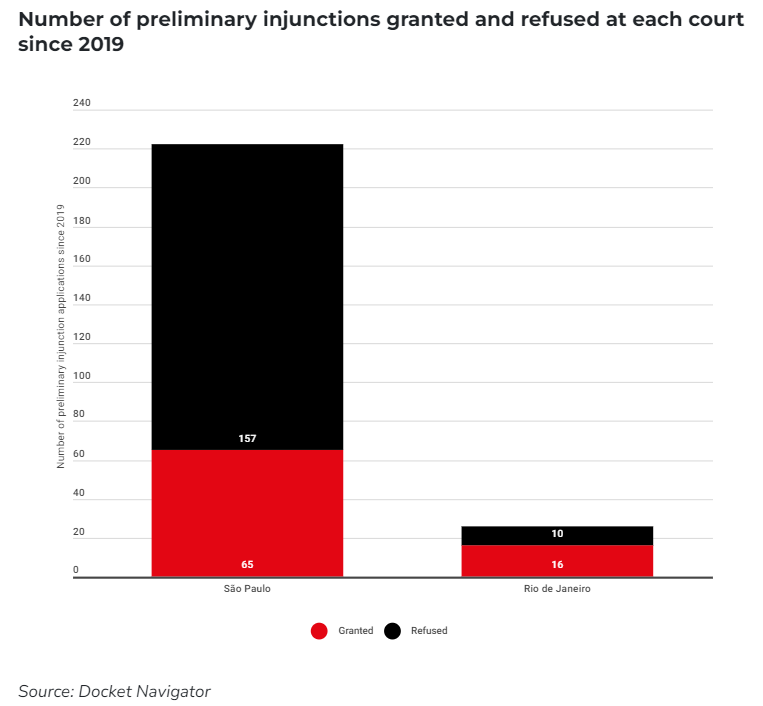
Sam Lovatt, 21 February 2024, Preliminary injunction practice at Brazil’s leading patent courts, IAM, https://www.iam-media.com/article/preliminary-injunction-practice-brazils-leading-patent-courts.
Moreover, because Brazilian judges hold broad discretion and often lack deep familiarity with SEP concepts, local counsel relationships can materially influence outcomes—sometimes even affecting decisions on whether to grant injunctions. Chinese companies should navigate these dynamics with care.
3. Strategies for Chinese Companies to Address Injunction Risks
As South America’s largest economy, Brazil is increasingly central to Chinese companies’ overseas growth. Yet its ambiguous SEP framework and stringent approach to injunctions require pragmatic and flexible risk-management strategies. Drawing on prior dispute-resolution experience, the PurpleVine team recommends the following:
1) Identify potential risks early and consider filing a declaratory judgment.
This can help secure a favorable forum before the patentee acts, preventing rights holders from suing in injunction-friendly courts such as Rio de Janeiro. The approach requires a sophisticated litigation team capable of predicting likely venues and assessing judicial tendencies.
2) Request reconsideration of the injunction.
Parties may ask the court to modify an injunction order based on procedural errors or new evidence.
3) Appeal the injunction.
Appeals are available but typically do not suspend enforcement, limiting short-term relief.
4) Provide a counter-guarantee.
Companies may offer a bank or account guarantee to suspend enforcement until a first-instance ruling. Because practices vary widely, businesses must assess judicial tendencies, required guarantee size, and cash flow impacts.
5) Balance market and compliance considerations.
Given the wide variation in daily fines, companies may, in limited circumstances, maintain market operations if the commercial cost of compliance outweighs potential penalties. However, persistent non-compliance can lead to contempt findings or even criminal liability. Decisions should thus be made with extreme caution.
Author
Vivian(Qin) Wang
Ms. Vivian (Qin) Wang is a qualified Chinese lawyer with 15 years of experience in the intellectual property industry. Her expertise spans the full IP value chain, from patent strategy and filing to licensing, litigation, and patent asset commercialization. She specializes in litigation management, patent licensing, and the monetization of IP assets. Her key areas of practice include patent licensing negotiations, litigation settlements, designing licensing programs, patent portfolio commercialization, and drafting licensing agreements. Prior to joining PurpleVine IP Group, she worked at ZTE Corporation and Longji Green Energy Technology Co., Ltd. Ms. Wang holds a Master’s degree in Law from Northwest University of Political Science and Law and is qualified as both a Chinese attorney and a Chinese patent attorney. Contact Vivian at vivian.wang@purplevineip.com.
Eren(Xi) HE
Before joining PurpleVine IP Group, Mr. Xi He worked at ZTE, where he was responsible for managing and executing licensing strategies related to communication standard essential patents (SEPs). With over six years of experience in the IP field, he has been involved in large-scale international cross-licensing projects, patent pool operations, as well as patent transactions and valuation analyses. Mr. He is well-versed in the policies of major international standards organizations, such as 3GPP, and specializes in the full life-cycle management of SEP portfolios, as well as business strategy and external negotiations in licensing operations. Contact Mr. He at eren.he@purplevineip.com.
Robin(Danlei) Feng
Ms. Danlei Feng, a licensing assistant at PurpleVine IP, has accumulated 2 years of experience, assisting the team in patent litigation searches, analysis, due diligence, and legal assessments in numerous global patent licensing and dispute resolution cases. These cases span multiple technical fields, including cellular communications (4G/5G), Wi-Fi, audio and video codecs (AVC/H.264, HEVC/H.265, VVC/H.266, VP9, AV1, AAC), wireless charging (Qi), and more. Ms. Feng holds a Master’s degree in Law from Sichuan University and is qualified to practice law in China. Contact Ms. Feng at robin.feng@purplevineip.com