

 INSIGHTS
 In recent years, the U.S. District Court for the Northern District of Illinois has become the focal point for large-scale intellectual property (IP) litigation against cross-border e-commerce sellers, commonly referred to as "Schedule A" litigation. In these cases, brand owners typically bring a single lawsuit against dozens or even hundreds of online sellers, alleging trademark, patent—particularly design patent—or copyright infringement. They also routinely seek ex parte temporary restraining orders (TROs) and asset freezes without prior notice to defendants, securing swift enforcement at the outset of proceedings. Favored by brand owners for its speed and efficiency in combating cross-border online infringement, the Schedule A model has nevertheless attracted growing criticism over its potential impact on defendants' due process rights.
Since 2024, criticism of the Schedule A model has gained momentum among judges, practitioners, and legal scholars.[1] That debate intensified in August 2025, when Judge John F. Kness of the Northern District of Illinois issued a landmark opinion in Eicher Motors Limited v. The Partnerships and Unincorporated Associations Identified on Schedule A (hereinafter "Eicher Motors").[2] Rejecting several practices that have long been central to traditional Schedule A litigation, Judge Kness’s decision signals a growing judicial reassessment of the model and could have significant implications for how similar cases are litigated in the future.
1. Anatomy of a Schedule A Case
Schedule A litigation is a large-scale IP enforcement model that has developed in the United States over the past decade to address widespread online infringement. The name derives from the "Schedule A" exhibit attached to the complaint. In this exhibit, plaintiffs identify defendants by their online storefronts and seller accounts rather than their legal names.[3] At the outset of a case, the complaint and related exhibits are typically filed under seal, meaning that only the court and the plaintiff have access to the list of defendants. As a result, the identities of the targeted sellers remain confidential during the early stages of the proceedings.
After commencing an action, plaintiffs almost invariably seek ex parte temporary restraining orders (TROs) and asset freezes, asking the court to grant such relief without prior notice to defendants. Once issued, a TRO typically directs e-commerce platforms and payment service providers to remove allegedly infringing listings and freeze funds associated with the defendants' accounts. In many instances, sellers do not learn that they have been sued until these enforcement measures have already taken effect. By the time they become aware of the litigation, their funds may have been frozen and their online storefronts disabled.
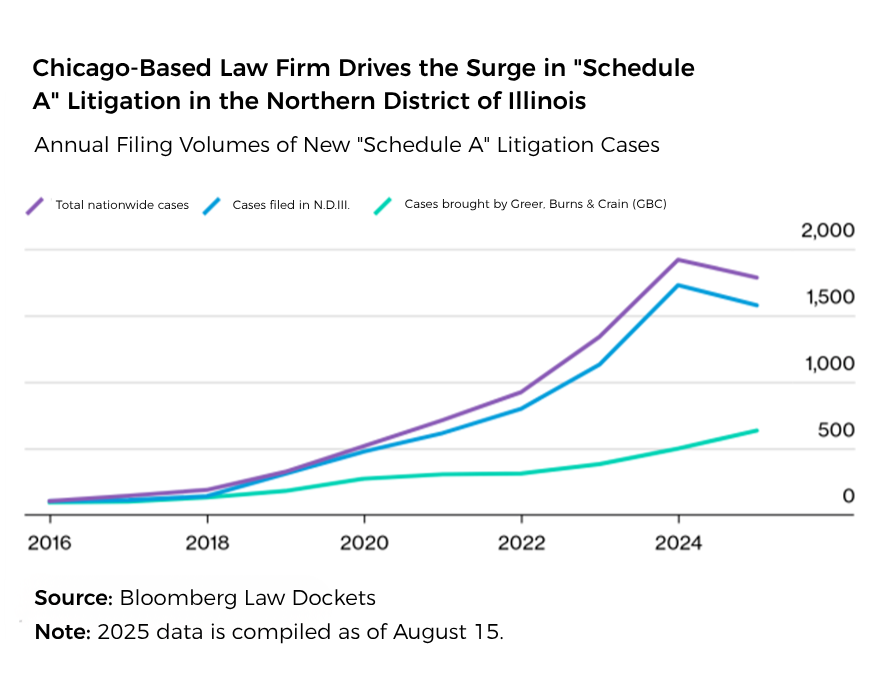
Growth of Schedule A Litigation in the United States, 2016–2025
(Purple: Total cases filed nationwide; Blue: Cases filed in the Northern District of Illinois; Green: Cases filed by GBC, a leading plaintiff-side law firm)[4]
The "enforcement first, notice later" approach rests on several procedural mechanisms available under U.S. law. Most notably, Federal Rule of Civil Procedure 65(b) allows courts to issue ex parte temporary restraining orders (TROs) when a plaintiff can demonstrate through specific facts that immediate and irreparable harm is likely to occur absent emergency relief. In Schedule A cases, plaintiffs routinely argue that defendants are overseas sellers whose identities and locations are difficult to ascertain. They contend that advance notice would enable defendants to dissipate assets, destroy evidence, or otherwise frustrate the enforcement of any eventual judgment.[5]
Historically, the Northern District of Illinois was receptive to such arguments and developed a well-established framework for handling Schedule A cases. Several judges, including Judge Pacold, have made available template orders for TROs, preliminary injunctions, and default judgments tailored specifically to Schedule A litigation on the court's official website.[6]
The Schedule A model has also played a significant role in design patent enforcement. For design patent owners, it offers an efficient means of pursuing multiple sellers accused of marketing products that allegedly copy protected designs while seeking remedies such as statutory damages and injunctive relief. At the same time, the America Invents Act (AIA) of 2011 imposed important limits on the joinder of unrelated defendants. Under 35 U.S.C. § 299, defendants may be joined in a single action only when the asserted claims arise out of the same transaction or occurrence.[7]
Even so, design patent cases involving large numbers of defendants were for many years routinely permitted to proceed in the Northern District of Illinois. Beginning in 2023, however, judges increasingly questioned the practice and required plaintiffs to demonstrate meaningful connections among co-defendants. In some instances, courts dismissed all defendants except the first-named party.[8] In November 2024, for example, three federal judges sustained defendants’ objections to improper joinder in multi-defendant trademark and patent infringement actions and ordered the claims severed into separate cases. One of those disputes involved an enforcement action brought by Toyota.[9]
A TRO remains in effect for 14 days, after which the court determines whether to issue a preliminary injunction (PI). If granted, the PI extends the injunctive relief and asset restraints throughout the remainder of the litigation. In practice, most defendants do not appear or actively contest the claims, and courts therefore frequently convert TROs into preliminary injunctions. Statistics show that between 2022 and 2024, the Northern District of Illinois granted ex parte TRO applications in 85 of 87 Schedule A design patent cases—an approval rate of nearly 98%.[10] Such a high approval rate has led critics to argue that Schedule A proceedings became largely routine over time.
Notably, plaintiffs in Schedule A litigation almost invariably seek statutory damages rather than actual damages or equitable relief. Under the Lanham Act, for example, a plaintiff may recover up to $2 million per counterfeit mark for willful infringement against each defendant. This framework relieves plaintiffs of the burden of proving actual losses or defendants' profits attributable to the infringement. As a result, successful plaintiffs often pursue statutory damages instead of more demanding equitable remedies such as disgorgement of profits.
That practice has, however, raised questions about the legal basis for prejudgment asset restraints. Federal appellate precedent generally holds that courts may not freeze a defendant's assets in actions seeking purely monetary relief unless the plaintiff seeks an equitable remedy that would justify such relief.[11]
2. Impact and Competing Perspectives on Schedule A Litigation
For defendants, many of whom are China-based e-commerce sellers, Schedule A litigation often arrives with little warning. Because filings typically remain under seal during the initial stages of a case, sellers may first learn of the proceedings only after their storefronts have been disabled and their accounts frozen.[12] Many overseas sellers are unfamiliar with U.S. litigation procedures and face practical challenges, including language barriers and the costs of retaining local counsel. Once assets are frozen, defendants generally face three choices: incur significant expense to defend the case in the United States, negotiate a settlement, or allow a default judgment to be entered. In practice, many choose either to remain inactive or to settle quickly in order to regain access to their funds and resume business operations.
As a result, the vast majority of Schedule A cases conclude without substantive participation from defendants. After obtaining a preliminary injunction, plaintiffs typically move for default judgments and seek statutory damages against non-appearing parties, while dismissing claims or reaching settlements with sellers who engage in the process. Few cases proceed to adjudication on the merits, and most are resolved once default judgments have been entered.[13] For many defendants, the practical outcome is either settlement or default. Critics argue that frozen assets can create substantial settlement pressure, leading parties to resolve disputes based on immediate business considerations rather than the strength of the underlying claims. In such circumstances, the merits of the dispute may never receive meaningful judicial scrutiny.
A number of legal scholars have criticized the Schedule A model, arguing that it departs from core principles of adversarial litigation. Professor Eric Goldman of Santa Clara University School of Law has famously described the process as an "Alice in Wonderland" proceeding in which "nothing is normal, yet everyone pretends it is."[14] He has also characterized the joinder of numerous defendants in Schedule A actions as a "regrettable pattern of IP litigation abuse," noting that unrelated sellers are often sued together simply because they offer similar products online.[15] In many cases, defendants operate independently and have no apparent relationship with one another, yet are named in a single action. Critics further contend that because most defendants default, courts frequently hear only one side of the dispute, raising concerns about procedural fairness and due process.[16]
Supporters of the model, however, argue that it reflects the realities of modern online enforcement. Justin Gaudio, a partner at Greer, Burns & Crain (GBC), a firm that has handled a substantial number of Schedule A cases, has described the approach as both "necessary and efficient" in the e-commerce environment. In his view, prior to the emergence of Schedule A litigation, brand owners often faced an endless "whack-a-mole" problem, expending considerable resources pursuing counterfeit sellers who could quickly reappear under new identities with little practical consequence.[17]
Judicial attitudes toward Schedule A litigation have also evolved. For many years, judges in the Northern District of Illinois routinely granted requests for TROs, asset freezes, alternative service, and default judgments. As noted above, Judge Pacold made available template orders for these cases, and courts frequently approved requests for mass joinder, electronic service, and default relief with limited scrutiny. Some commentators have described this approach as judicial "rubber-stamping."[18]
In recent years, however, courts have shown increasing skepticism toward certain aspects of the model. In December 2023, Judge Steven Seeger denied a TRO application against 310 defendants in Zorro Productions, Inc. v. Does 1–310 and criticized the plaintiff's litigation strategy. He observed that the plaintiffs sought to proceed without notice and emphasized that ex parte restraining orders are intended to remain an extraordinary remedy rather than become routine practice.[19] Throughout 2024, several judges dismissed defendants from Schedule A cases after finding insufficient connections among the parties to justify joinder.[20] Taken together, these developments suggest a growing willingness among courts to re-examine procedural assumptions that long underpinned Schedule A litigation.
3. Eicher Motors: Judge Kness’s Ruling and Its Implications
On August 8, 2025, Judge John F. Kness issued a 24-page opinion in Eicher Motors Limited v. The Partnerships and Unincorporated Associations Identified on Schedule A. The decision represents the most comprehensive and searching judicial examination of the Schedule A model to date.[21]
The case was brought by Indian motorcycle manufacturer Eicher Motors against 50 online sellers accused of offering products bearing counterfeit ROYAL ENFIELD trademarks on platforms including AliExpress. Consistent with the approach commonly adopted in Schedule A litigation, the plaintiff sought leave to file its complaint under seal and applied for an ex parte TRO and related asset restraints. Rather than granting the requested relief, however, Judge Kness used the case as an opportunity to examine the procedural foundations of the Schedule A model.
The Court's Core Holdings
Judge Kness concluded that several features of the traditional Schedule A framework raise substantial questions under the Federal Rules of Civil Procedure (FRCP) and fundamental principles of due process. His opinion questioned whether a number of long-standing procedural practices can continue to withstand judicial scrutiny in their current form. The court's principal findings are summarized below:
a. FRCP 65(b): Misuse of Extraordinary Procedures
b. The Traditional Injunction Factors Do Not Support TRO Relief
Judge Kness also concluded that the traditional factors governing injunctive relief weighed against granting the requested TRO. He emphasized the importance of judicial transparency, observing that keeping large numbers of court filings and defendants' identities under seal for extended periods is difficult to reconcile with the principle of open judicial proceedings. He further noted that injunctions are often most effective when publicly known to platforms, and other market participants. By contrast, the extensive confidentiality that characterizes many Schedule A cases—where significant portions of the record remain sealed until after a TRO has been executed—limits public oversight and reduces transparency regarding both the proceedings and their outcomes.
c. FRCP 20: Questions Over Mass Joinder
Judge Kness also questioned the practice of joining dozens or even hundreds of defendants in a single action. He reasoned that allegations involving the same intellectual property right, standing alone, do not provide a sufficient basis for joinder.[22] Under the Federal Rules of Civil Procedure, joined defendants must be connected through the same transaction, occurrence, or series of transactions or occurrences—a requirement that is often difficult to satisfy where online sellers operate independently of one another. Accordingly, Judge Kness suggested that conclusory allegations unsupported by specific factual evidence are unlikely to satisfy the joinder requirements of Rule 20(a)(2).[23]
Overall, Judge Kness's opinion in Eicher Motors marks a significant development in the judicial treatment of Schedule A litigation. Rather than granting the forms of relief that have traditionally been sought—and frequently obtained—in such cases, he used the occasion to examine several of the model's defining features, including ex parte proceedings, sealed filings, prejudgment asset restraints, and mass joinder.
Notably, the opinion did not emerge in isolation. On June 9, 2025, two months before issuing his decision in Eicher Motors, Judge Kness sua sponte stayed all pending Schedule A cases on his docket in R Corp. v. The Partnerships and Unincorporated Associations Identified on Schedule A.[24] In doing so, he signaled concerns about whether certain procedural practices commonly employed in these cases were consistent with the Federal Rules of Civil Procedure and broader principles of fairness. During that review, the court identified five principal issues for further examination, many of which ultimately formed the basis of the Eicher Motors opinion. Taken together, these actions suggest a growing willingness to re-examine assumptions that have long underpinned Schedule A litigation in the Northern District of Illinois.
The decision has already attracted considerable attention among practitioners and observers of online IP enforcement. Although the decision is not binding precedent, its practical influence may prove significant. In the weeks following the decision, commentators reported that judges elsewhere in the Northern District of Illinois appeared increasingly willing to scrutinize TRO applications that might previously have received little resistance.[25]
The debate surrounding Schedule A litigation is therefore far from settled, and several important questions remain unresolved:
4. Conclusion
Born out of the practical challenges of combating online counterfeiting, the Schedule A litigation model has played a significant role in intellectual property enforcement over the past decade. At the same time, its widespread use has generated ongoing debate over procedural fairness and the extent to which defendants' due process rights are adequately protected. For many years, the Northern District of Illinois served as the principal forum for large-scale Schedule A litigation. Recent developments, however—most notably Judge Kness's 2025 opinion in Eicher Motors—suggest that courts are becoming increasingly willing to re-examine some of the procedural assumptions that have long underpinned the model.
Looking ahead, requests for mass joinder, ex parte relief, and prejudgment asset restraints are likely to face closer judicial scrutiny in the Northern District of Illinois and potentially in other jurisdictions as well. Such developments may help curb procedural abuses and strengthen safeguards for defendants, while at the same time creating new challenges for rights holders seeking to combat large-scale online infringement. How courts strike this balance will remain an important issue to watch in the years ahead. Businesses engaged in cross-border e-commerce and their legal advisers should closely monitor these developments and assess their implications for future enforcement and defense strategies.
Reference
[1] Brakes Slammed on Schedule A Litigation: A Turning Point for Defendants in the Northern District of Illinois? https://www.pb-iplaw.com/brakes-slammed-on-schedule-a-litigation-a-turning-point-for-defendants-in-the-northern-district-of-illinois/
[2] Eicher Motors Limited v. The Individuals, Corporations, Limited Liability Companies, Partnerships, and Unincorporated Associations Identified on Schedule A Hereto N.D.Ill. No. 1:25-cv-02937
[3] Eicher Motors Limited v. The Individuals, Corporations, Limited Liability Companies, Partnerships, and Unincorporated Associations Identified on Schedule A Hereto N.D.Ill. No. 1:25-cv-02937
[4] Judge's 'Schedule A' Rebuke Reignites Anti-Counterfeiting Debate https://news.bloomberglaw.com/ip-law/judges-schedule-a-rebuke-reignites-anti-counterfeiting-debate
[5] Eicher Motors Limited v. The Individuals, Corporations, Limited Liability Companies, Partnerships, and Unincorporated Associations Identified on Schedule A Hereto N.D.Ill. No. 1:25-cv-02937
[6] District Court for the Northern District of Illinois https://www.ilnd.uscourts.gov/_assets/_documents/_forms/_judges/Pacold/TRO%20Template%20Schedule%20A%20cases.pdf
[7] 35 U.S.C. §299 (b) For purposes of this subsection, accused infringers may not be joined in one action as defendants or counterclaim defendants, or have their actions consolidated for trial, based solely on allegations that they each have infringed the patent or patents in suit.
[8] Design Patent Data: Firms Navigate Enforcement Spike https://www.finnegan.com/en/firm/news/design-patent-data-firms-navigate-enforcement-spike.html
[9] Brakes Slammed on Schedule A Litigation: A Turning Point for Defendants in the Northern District of Illinois? https://www.pb-iplaw.com/brakes-slammed-on-schedule-a-litigation-a-turning-point-for-defendants-in-the-northern-district-of-illinois/
[10] 'Schedule A' Cases: A Powerful Tool for Enforcing Design Patents
[11] CSC Holdings, Inc. v. Redisi, 309 F.3d 988, 996 (7th Cir. 2002) (citing Grupo Mexicano de Desarrollo S.A. v. Alliance Bond Fund, Inc., 527 U.S. 308, 333 (1999))
[12] NDIL Shreds the "Schedule A" Playbook: Specificity Required - Miller Johnson
[13] Eicher Motors Limited v. The Partnerships and Unincorporated Associations Identified on Schedule "A", No. 25-cv-02937 (N.D. Ill. Aug. 8, 2025)
[14] Judge's 'Schedule A' Rebuke Reignites Anti-Counterfeiting Debate
[15] Brakes Slammed on Schedule A Litigation: A Turning Point for Defendants in the Northern District of Illinois?
[16] After "Schedule A": The Cross-Border IP Enforcement Gap
[17] Judge's 'Schedule A' Rebuke Reignites Anti-Counterfeiting Debate
[18] Judicial Discretion: Chicago-Kent Professor Cited by Federal Judge
[19] Zorro Productions, Inc. v. The Individuals, Corporations, Limited Liability Companies, Partnerships, and Unincorporated Associations Identified on Schedule A Hereto, No. 1:2023-cv-05761 - Document 36 (N.D. Ill. 2023)
[20] Brakes Slammed on Schedule A Litigation: A Turning Point for Defendants in the Northern District of Illinois?
[21] Eicher Motors Limited v. The Individuals, Corporations, Limited Liability Companies, Partnerships, and Unincorporated Associations Identified on Schedule A Hereto N.D.Ill. No. 1:25-cv-02937
[22] Estee Lauder Cosms. Ltd. v. Partnerships & Unincorporated Associations Identified on Schedule A, 334 F.R.D. 182, 187–90 (N.D. Ill. 2020)
[23] Bailie v. Partnerships & Unincorporated Associations Identified on Schedule A, 734 F. Supp. 3d 798, 802–04 (N.D. Ill. 2024)
[24] R Corp. v. The Partnerships and Unincorporated Associations Identified in Schedule A, No: 1:25-cv-06337 (N.D.Ill 2025)
[25] Judicial Discretion: Chicago-Kent Professor Cited by Federal Judge
https://kentlaw.iit.edu/law/news-media/news/judicial-discretion-chicago-kent-professor-cited-federal-judge
[26] Patent Litigation in the S.D.Fla. and Schedule A Cases https://www.lexisnexis.com/community/insights/legal/lex-machina/b/lex-machina/posts/patent-litigation-in-the-s-d-fla-and-schedule-a-cases
[27] SharkNinja Operating LLC et al v. THE INDIVIDUALS, CORPORATIONS, LIMITED LIABILITY COMPANIES, PARTNERSHIPS, AND UNINCORPORATED ASSOCIATIONS IDENTIFIED ON SCHEDULE A S.D.Fla. 1:25-cv-25323-RAR
[28] Limited v. The Individuals, Corporations, Limited Liability Companies, Partnerships, and Unincorporated Associations Identified on Schedule A Hereto N.D.Ill. 1:25-cv-09534
Author
Ude Lu
Attorney Ude Lu has over 10 years of U.S. intellectual property practice experience, plus eight years of R&D experience in electronics, motors and neural engineering. He is deeply familiar with patent litigation in U.S. district courts, inter partes review proceedings before the U.S. Patent and Trademark Office, and Section 337 investigations at the U.S. International Trade Commission (ITC). He has defended listed enterprises across industries including electronics & motors, software development, medical devices and biopharmaceuticals (including well-known biotech and generic pharmaceutical companies) in numerous patent lawsuits. He previously held positions at U.S. law firms Norton Rose Fulbright and Cozen O'Connor. Attorney Lu's practice areas consist of U.S. district court patent litigation, USPTO inter partes review, ITC Section 337 investigations, patent prosecution, patent searching, patent analytical research and patent portfolio development.